Objects for a changing workspace
By Michael Santiago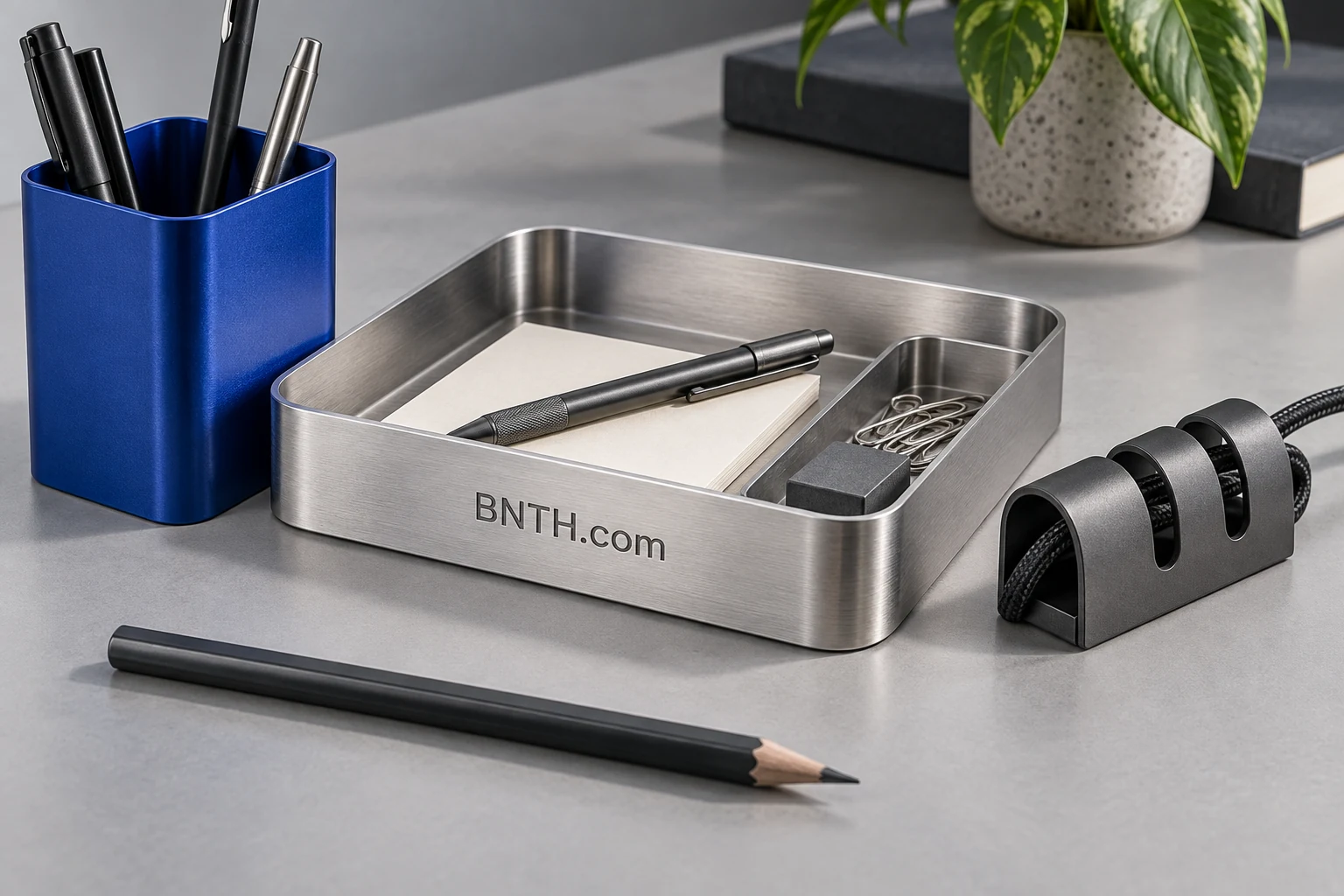
BNTH.com could become the address for a design-led workspace product business built around a small family of compatible objects. This is an illustrative business concept. Imagine a desk tray that holds the things people reach for every day, then a matching stand or cable guide that fits the same footprint. The customer might be someone setting up a shared home office, a small studio fitting out its worktables, or a retailer looking for a tightly edited collection. The first offer should solve one visible problem on a real desk.
Choose the object before the collection
Start with a desk observation. Ask a participant to show where their phone, notebook, charging cable, and loose adapters sit during a normal working day. Notice what they move when they need space for a different task. Take measurements with permission and distinguish personal preference from a repeated obstacle. A beautiful tray that requires moving everything else may be less useful than a smaller object that makes one transition easier.
The first product could be a folded-metal catchall with a removable divider. Define the intended contents and the maximum desk space it should occupy. Make a rough cardboard version before selecting the finish. A full-size mockup can answer whether the object blocks a laptop cable or makes a notebook awkward to pick up. The initial test does not need production quality. It needs enough physical accuracy to reveal whether the dimensions are sensible.
Build compatibility into a simple rule
A modular collection needs an understandable relationship between its pieces. One possible rule would be a common base depth, with widths in two compatible increments. Another would be a shared accessory attachment point. Choose the relationship that serves the customer's task and document it. If the promise is that pieces align, test actual samples side by side. Do not use “modular” as a label for unrelated objects that merely share a color.
For an illustrative first release, the tray might accommodate a notebook upright at the back and small items at the front. A second piece could hold a phone at a usable viewing angle without occupying the notebook space. The test would ask someone to clear the desk for handwriting and then restore their usual setup. Observe the movements, the objects left loose, and the moments when a participant changes the arrangement. Those details can guide the next prototype more effectively than a general rating of the appearance.
Treat materials as practical choices
Brushed aluminum and powder-coated steel would suit the visual direction shown here, but material selection should follow the product requirements. Ask suppliers about achievable tolerances, edge treatment, finish samples, minimum quantities, and packaging requirements. Compare samples under the lighting in which the object will be used. A finish selected from a screen image may look different on the physical product, so make the sample itself part of the decision.
Include contact points in the prototype review. Check the edges someone grips, the underside touching the desk, and the surfaces that meet a phone or laptop. Record observed scratches, slips, and awkward movements without inventing a durability claim from a brief session. If a product needs specialist safety or compliance assessment, obtain that assessment before making related promises. Early user feedback answers usability questions; it is not a substitute for appropriate product testing.
Run a small, observable concept test
Recruit five people whose working habits resemble the intended customer's habits. Ask each to use the same prototype for a few ordinary tasks. Introduce the test as a review of the object, not of the participant. The GOV.UK guide to moderated usability testing explains the value of observing people attempting tasks. Adapt that approach to the physical object and keep your conclusions limited to what the sessions actually show.
Use a short record for each session: task attempted, observed difficulty, participant comment, and proposed change. Keep observations separate from your interpretation. “The participant lifted the tray with both hands” is different from “the tray is too heavy.” The first statement is evidence; the second needs investigation. After the sessions, choose one or two changes that address repeated friction. Preserve a version of the original prototype so the comparison is possible.
Work backward from a deliverable order
Before accepting orders, understand the full path from supplier to customer. Request a sample shipment, inspect the packaging, and estimate the space needed to store a small batch. Think through damaged goods, replacement parts, and clear assembly instructions if any are needed. A product that looks compact on a desk may need more protective packaging than expected. Put those costs into the working model alongside manufacturing, fulfillment, and customer support.
The first distribution path could be direct sales with clear product demonstrations, followed by conversations with a few independent design shops. Photograph the actual product performing the task, including the empty state and the objects it accommodates. Provide dimensions in a readable diagram. A short video of moving from laptop work to handwriting could communicate the point of the design without exaggerated claims about productivity. Customer feedback from the initial batch should inform the second item in the collection.
Give the brand room to develop
BNTH.com could carry a restrained product identity that works on a small metal base, a packaging label, and an online shop. Its letters do not prescribe a material or one specific room, leaving the future owner to define the business through the products. Begin with the tray, the intended user, and a clear prototype question. The broader collection can wait until those choices have been tested. To explore this direction, prototype one useful desk accessory and inquire about BNTH.com with a short description of the business you want to build.